
This newsletter is different from my usual deep dives. Today, I'm making a prediction, one based on field data I collected, supply chain logic from my automotive background, and a pattern I've seen play out many times in the industry.
My thesis: XCharge will become EnBW's second charger supplier.
Let me explain why.
The Supplier Concentration Problem
EnBW operates Germany's largest fast charging network, over 8,000 fast charging points, nearly twice as many as the second largest fast CPO, Tesla, with roughly 3,800. Their target is 20,000 by 2030, revised down from 30,000 last year due to a strategic recalibration.

EnBW Charging Site: Pic Source: EnBW
What's less visible from the outside is how dependent EnBW is on a single hardware supplier. EnBW started with ABB Terra 53/54 chargers for their initial DC rollout in 2016. Since 2018, they have been almost solely purchasing from Alpitronic, which launched their HYC All in One fast chargers in 2017. Today, my estimate is that roughly 7,000 to 7,300 out of their 8,000+ charge points are Alpitronic hardware. I've also observed a couple of sites where they've been replacing their old ABB hardware with Alpitronic chargers, easy to spot as these replacements are limited to 100 kW due to grid constraints. One example I found was at Riedlinger Str. 30, Ehingen. This was an ABB T5x CJG - i.e. 50 kW CCS + 50 kW CHAdeMO + 43 kW AC. Now in the EnBW app it says 2x 100 kW CCS connectors.

EnBW mobility+ App shows a 2x CCS-2 Charger with max 100 kW
But this is a massive concentration problem.
Having spent five years at Schaeffler managing sales to Toyota, Honda, GM, and Opel, I have never seen a major OEM work with only one supplier for a critical component. Not once.
The reason is straightforward: single supplier dependency creates compounding risk. The supplier, realizing their monopoly position, can command higher prices, become lenient on response times and service levels, or negotiate terms that increasingly favor them. The buyer is also fully exposed to supply chain disruptions. If parts are delayed, there's no fallback. And quality discipline tends to erode when a supplier knows they won't lose the business regardless of performance.
There's another dimension that doesn't get discussed enough: cybersecurity. A single supplier network means a single attack surface. If a security vulnerability is discovered in one manufacturer's firmware, every charge point in the network is exposed simultaneously, with no fallback. Diversification isn't just a procurement strategy anymore. It's becoming a cybersecurity strategy.
EnBW knows all of this. Their CTO for E-Mobility, Volker Rimpler, said it directly: "The dependency on a single supplier carries risks, especially in times of global uncertainty and supply chain challenges."
Enter XCharge, and the Timeline That Matters
On December 22nd, 2025, EnBW publicly announced an expanded field test with XCharge. Ten charging stations across four locations in Baden-Württemberg: EnBW City in Stuttgart, Rutesheim, Durlach Center in Karlsruhe, and Karlsruhe Hauptbahnhof.
Boy, this came as a huge surprise for me and also the EU e-mobility community, which was enjoying their Christmas break. I posted a quick video about it that spread faster than expected. I had to take it down because I'd framed my assumption as more definitive than it was. Since then, I've been very careful about how I present this. 😅

Source: EnBW Press Release Confirming Pilot of 10x XCharge Chargers in their Network
But the backstory goes deeper.
EnBW had already installed a single XCharge unit at their Stuttgart EnBW City location in August 2025. And in their December press release, they confirmed having conducted over two years of lab testing, analysing several thousand charging sessions and confirming that XCharge has so far met all requirements in terms of technology, service, data protection, and software.
Two years of lab testing. Rolling out one charger, then nine more, ten total across four sites. This is not how you test a technology you're unsure about. This is how you qualify a supplier you plan to work with.
Now, one could argue that XCharge is simply first in line and others will follow the same process, as EnBW is evaluating different charger manufacturers as well. That's possible. But the depth and pace of this qualification tells its own story.
I inspected the nameplates of all the XCharge units in Karlsruhe. Every single one was manufactured in October 2025. You don't manufacture brand new hardware for a pilot unless the chances for success are already very high.

XCharge C7 - 400 kW Nameplate - Installed in EnBW Network, Germany
XCharge is Not a Small Name
Before I share the site experience and the data, some context on who XCharge is. This is not a startup entering Europe for the first time.
XCharge (Nasdaq: XCH) was founded in 2015 in Beijing and has been operating in Europe since 2018, when they established their European HQ in Hamburg. They have an installed base of 9,000+ chargers worldwide, with nearly 3,000+ chargers in EU, with majority of them being fast chargers. They hold 69 patents.
What stands out is the infrastructure investment they've made in just the last two years. In 2023, they opened a test lab with SGS in Madrid, Spain. In 2024, they opened a dedicated test lab at their Hamburg, Germany headquarters for full product testing. In 2025, they expanded with a new technical centre near Madrid, with offices, test lab and logistics warehouse to improve reaction times.
I've briefly crossed paths with the XCharge team at several industry events over the past years and what consistently comes through is their focus. They aren't spreading thin. They know exactly who to work with and in which markets. In a landscape where many charger manufacturers overextend, that strategic discipline stands out.
The full company profile, including product portfolio, financial analysis (revenue, net income, gross margins from 2021 to H1 2025), and their Nasdaq SEC filings, is in the report.
First Impressions from the Sites
Before the data, let me share my site experience.
Design and visibility. The chargers have a clean design and what immediately stands out is the display. It's a high-quality screen with good pixel density, and CPOs could use it to display their offers, promotions, or pricing. By comparison, Alpitronic uses a static HMI with loadable images that change after few seconds, but the screen sits on the side of the unit and most drivers simply start their session and walk away. It is still better than what I've seen at some other CPOs, printing and pasting offers on their chargers. But for XCharge, the screen is at the centre and separate from the charger touch screen. I liked it. How much consumers appreciate this is a different story, and I don't have the data on how much it will generate in sales or promotion conversions.
The LED lighting is also worth noting. At Durlach Center, the XCharge units were easy to locate from 100 to 200 metres away. The Alpitronic chargers on the same site? Not visible from that distance at all. Sadly, the camera pics aren’t doing justice, so you have to witness yourself. But here is a pic from a closer yet reasonable distance.

Side by Side Comparison of XCharge and Alpitronic - EnBW, Durlach Center Karlsruhe
Cables. The cables are 5.5 metres, Huber+Suhner, and appear to be RADOX® HPC500 CCS2, liquid cooled. However, pulling the cable out of the charger socket required more force than expected. I think the socket design works well in principle, but the connectors are placed at a lower height to comply with barrier free requirements, and at that height the added force becomes more noticeable. This could be due to the angle they are installed at, or due to the connector design itself, as other connector manufacturers have a grip handle to hold and maneuver the connector. Once the connector was out, it was difficult to maneuver, as the cable management system design causes the lower part of the cable to get tangled with the cable outlet. One suggestion: move the cable exit point on the charger a few inches higher. That alone should solve the tangling issue.

XCharge C7 Connector and Cable Management System, EnBW Durlach Center Karlsruhe
AC contactor sound. One thing I noticed immediately was the loud sound the AC contactors made, both during charging and for roughly five minutes after the session ended. I posted a video about it on my socials and got a brilliant explanation from an industry contact: as a charger manufacturer, you either place AC contactors inside the power modules or outside. If inside, the sound is dampened, but it means more points for failure and a contactor failure means replacing the entire power module, and that's expensive. If outside, the sound is louder, but replacement is cheap and fast. XCharge chose the maintenance friendly route. At scale, that's a smart engineering trade off. And, this is extremely important, UNLESS you work in the industry, you will not even notice this thing. 😄
The Field Data
This is where my approach differs from desk research. I physically visited both Karlsruhe locations multiple times between December 2025 and February 2026, reading the cumulative energy figures displayed on the LEM DC meters installed in each charger.
Having worked with LEM meters during my time at ABB E-Mobility, I know how to read them. These meters are the hidden players making the EV charging ecosystem work, ensuring consumers pay accurately for the energy they receive while fulfilling compliance requirements. I plan to write a dedicated piece on DC meters in the future.

LEM DC Meter (DCBM) Installed in XCharge C7, operated by EnBW Karlsruhe
Conversations with regular drivers at both sites suggest the chargers went operational roughly two to three weeks before the press release date. I don't know the exact date, but for my calculations, I'm using December 8th, 2025 as the operational start date.
What makes these numbers particularly significant is that EnBW didn't choose these locations randomly. Both Karlsruhe sites previously operated Alpitronic 300/400 kW chargers, meaning EnBW had historical throughput data for these exact locations. By replacing existing chargers with XCharge units at known high-performing sites, they created a direct, apples-to-apples comparison.
Here are the headline numbers after approximately 10 weeks of operation:
Location 1: Durlach Center, Karlsruhe 2 XCharge C7 chargers · 4 charge points · 300 kW each · Located near the A5 highway exit
181,000 kWh total energy dispensed in 71 days
637 kWh per charge point per day → 37.9% utilisation

2x XCharge C7 Chargers Installed at Durlach Center, Karlsruhe - EnBW

2x Alpitronic HYC 300 Chargers Installed at Durlach Center, Karlsruhe - EnBW
Location 2: Hauptbahnhof, Karlsruhe 4 XCharge C7 chargers · 8 charge points · 400 kW each · Behind the central train station
153,500 kWh total energy dispensed in 71 days
270 kWh per charge point per day → 16.1% utilisation

4x XCharge C7 Chargers Installed at Backside of Hauptbahnhof, Karlsruhe - EnBW

4x Alpitronic HYC 300 Chargers Installed at Backside of Hauptbahnhof, Karlsruhe: Pic Source: GoingElectric
Combined, these 12 charge points have dispensed over 334,500 kWh in roughly 10 weeks.
For context, most German CPOs for fast charging average around 8 to 10% utilization for HPCs. Durlach Center is running at nearly 4x that.
These are winter numbers. EV consumption is typically 20 to 30% higher in winter. Summer throughput will likely be lower per session, but charging sessions tend to be shorter (vehicles reach peak charging speeds at optimal battery temperatures around 25°C), which may increase the number of sessions per day.
The Full Report
After XCharge was installed at EnBW, I spent over two months researching the company, analyzing their financials, and physically visiting their Karlsruhe pilot sites multiple times to read energy meters across all 12 charge points.
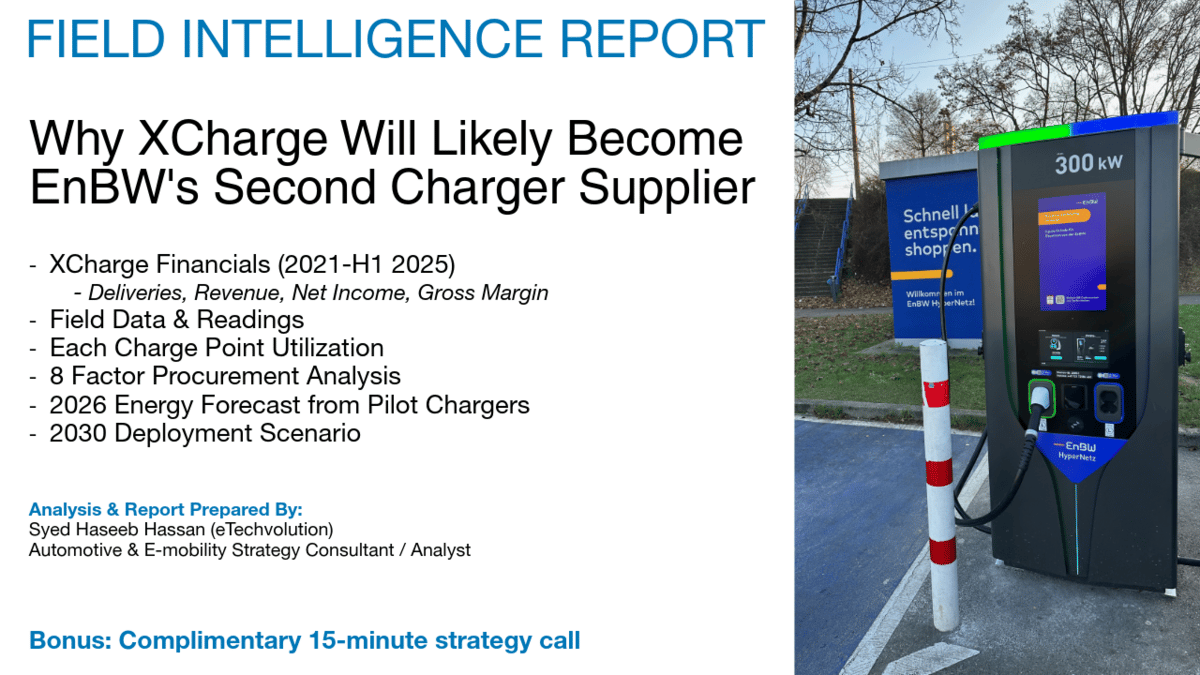
This is a 24 pages field intelligence and strategic analysis. Here's what's inside:
XCharge financials including deliveries, net income, and gross margin (2021 to H1 2025). Every individual charge point reading across multiple site visits. Per charge point utilisation at EnBW test sites. Estimated number of charging sessions. 2030 EnBW supplier diversification scenario. Photographic proof.
Plus an 8 factor procurement analysis explaining why XCharge will likely win this, including a direct parallel to how ABB's A400 qualified with Fastned.
Who is this for? If you're a CPO evaluating new charger suppliers, a charger manufacturer sizing up the competitive landscape, a consultant advising clients on EV infrastructure, or an investor tracking XCharge's finances and operations, this report gives you the data to make decisions, not guesses.
Every purchase includes a complimentary 15-minute strategy call with me.
What the Drivers Told Me
The numbers are impressive. But I also spent a significant amount of time talking to EV drivers at both sites, regular commuters and travelers passing through.
The feedback was overwhelmingly positive. Drivers were happy with the chargers. They found them reliable, the charging experience was smooth, and multiple people told me they had no complaints at all. Across all my visits to both Karlsruhe locations, I never observed an XCharge C7 unit out of service. Not once. Meanwhile, during the same period, a nearby Alpitronic HYC 150 at Durlach was out of order for approximately one week. I don’t have a picture from 19 Jan 2026, therefore I took a screenshot of a video I recorded on this site.

1x Alpitronic HYC 150 Out of Order in CW 04/2026 - Durlach Center, Karlsruhe - EnBW Site
I did record two minor incidents across the entire observation period. What they were, how they were resolved, and what they tell us about XCharge's hardware robustness is documented in the report.
What Could Be Improved
HMI / Display. As a geek, the first thing I like to observe is a charging curve. The charging curve is available, but you have to find and press a small "!" button on screen. Most drivers I spoke to didn't know it was there. A clear label or arrow pointing to it would improve the experience immediately. I also have OCD at times, sorry, but the SOC indicator cell on the display sits too far at the edge of the screen. 😅

Charging Details and Charging Curve on XCharge C7 - EnBW Karlsruhe
Payment terminals. I think this is not an XCharge issue, but rather from EnBW. On these two sites, the payment terminal, a newly installed Payter Apollo, is turned off. Perhaps on instructions from EnBW, they are not being used. So for the 334,500 kWh energy delivered on these two sites so far, payment with credit card was not possible, and that needs to improve. We are all pushing for AFIR compliant chargers, meaning the possibility to pay with credit cards. If that were also part of it, perhaps there could have been additional data collected in this pilot phase.
But due to this mismatch, a slight improvement potential for XCharge: the authentication options shown on screen don't fully match what's actually available. The demo video shows people can pay with credit card, but it is currently inactive. So you could create a new demo for such stations.

Payment Terminal and User Journey at XCharge C7, installed at EnBW Karlsruhe
Plug & Charge behaviour. Last thing, again not XCharge specific but for the whole industry. I observed that when using AutoCharge or Plug & Charge, the charging session can be stopped by pressing the stop button on screen. The only reason I am including it here is that I met a person who had driven their BMW i5 to Durlach Center Site, and it was their first charging session. This person asked what happens if you press stop, and me being overconfident said, nothing. The charger should ask you to re-present your authorization method. Let me show you. And embarrassingly enough, it stopped. I had to apologize multiple times but I didn't understand what happened. 😅
After posting it on social media, I got the feedback that this is fairly common with AutoCharge or Plug & Charge. This seems like something the industry needs to address.
Why I Think XCharge Wins This
I've spent weeks analyzing this from a procurement and supply chain perspective, drawing on my experience at Schaeffler and ABB E-mobility. In the report (linked above), I lay out 8 factors that point to XCharge becoming EnBW's second strategic supplier, including a direct parallel to how ABB's A400 charger qualified with Fastned through pilot sites. If you've worked in automotive or industrial procurement, you'll recognize the pattern immediately.
The Bigger Picture
This isn't just about XCharge or EnBW. It's about the maturation of the European EV charging market.
Gone are the days when out of order chargers were tolerated. The market is fighting to survive, and CPOs need their chargers working around the clock for their business cases and TCO calculations to hold up. Charger reliability is no longer a nice to have. It's existential for CPOs.
I want to see more manufacturers compete at this level, because the market desperately needs it. Competition drives improvement. And if XCharge's performance in Karlsruhe is any indication, the competition just got more interesting.
Disclaimer: This is not a promotional post. I am not paid by XCharge, EnBW, or anyone else. Not yet, at least, and I hope that changes soon. 😅
How to Work with Me
I'm Syed Haseeb Hassan, Automotive & E-mobility Consultant / Analyst with 9 years of experience in the European charging and automotive sectors.
Schaeffler (5 years): GM, Toyota, Honda, Opel, McLaren
ABB E-Mobility (4 years): Shell, TotalEnergies, major installers and service providers
Are you looking for detailed research to understand market trends, competitive positioning, and how to position your product or strategy?
I provide the same level of analysis for:
- EV Charging Infrastructure Strategy and Competitive Positioning
- Pricing Models and Utilization Benchmarking
- CPO Business Models and Market Entry Strategy
- Automotive Trends and Global Policy Shifts
Let's discuss your challenge: [email protected]
Also kindly share if you liked this Newsletter. This will help me to improve.
Thanks and till next week,
Haseeb